Why Buying an Apartment on ITPL Main Road Whitefield Is the Smartest Property Decision You Can Make in Bangalore Right Now
Why Buying an Apartment on ITPL Main Road Whitefield Is the Smartest Property Decision You Can Make in Bangalore Right

Walk into any real estate sales office on Sarjapur Road and you’ll be handed a brochure that lists the same things: a swimming pool, a clubhouse, landscaped gardens, a gym, sports courts, children’s play area. The amenity list has become completely standardized across every project on this corridor, regardless of whether the development sits on 3 acres or 30. What that list doesn’t tell you — and what most brochures deliberately avoid making clear — is how many families will be sharing those amenities. That number, not the list itself, is what actually determines your quality of life inside the community.
This is why low density apartments have become one of the most searched and least understood concepts among serious Bangalore homebuyers in 2026. This guide explains what density actually means in practical terms, why it matters specifically on Sarjapur Road, and how to evaluate it properly before you book.
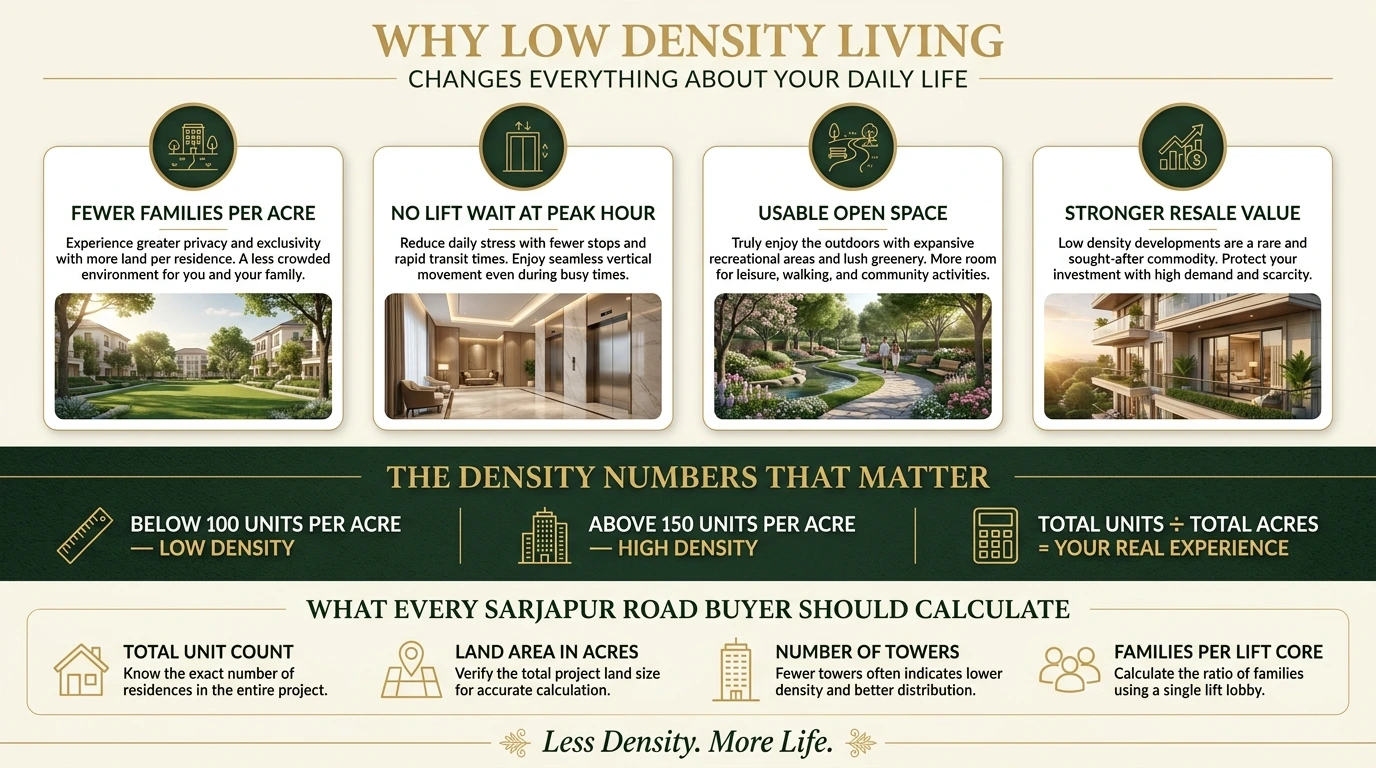
Density in residential real estate has one straightforward measure: the number of homes per acre of land. The higher that number, the more families sharing the same pool, the same lift lobby, the same guest parking, the same jogging track. The lower that number, the more space each family effectively has — not just inside their apartment, but across the entire community they live in.
Here is a simple way to understand it: a project with 600 units on 4 acres works out to 150 families per acre. A project with 440 units on 5.5 acres works out to roughly 80 families per acre. On paper that sounds like a minor difference. In daily life it is the difference between a 10-minute wait for a lift during peak morning hours versus a 2-minute wait. It is the difference between a swimming pool that feels like a weekend resort and one that feels like a public bath during summer holidays. It is the difference between guest parking that actually works and one where visitors circle the gate for 20 minutes.
Low density does not mean a smaller project or fewer amenities. It means fewer people competing for the same shared resources — and that distinction is entirely invisible in any brochure that only lists what the amenities are without telling you how many residents will use them.
Sarjapur Road has seen an explosion of new residential supply over the last three to four years. Developers sitting on large 10 to 20 acre land parcels have almost universally responded by maximizing unit count — stacking 30 to 40 floor towers, building 4 to 6 blocks per parcel, and selling 800 to 2,000 unit townships. This makes financial sense for developers. It does not necessarily make lifestyle sense for the buyers who move in.
The resulting density math across most of these townships is punishing. A 1,500 unit development on 12 acres works out to 125 families per acre. A 2,000 unit township on 15 acres is the same ratio. Once you apply that number to shared amenities — typically a single clubhouse regardless of project scale, one or two swimming pools, a fixed number of lift cores per tower — the per-family resource availability shrinks to the point where the “premium lifestyle” promised in the brochure exists mainly at 7 AM on a Tuesday morning.
This gap between marketed amenities and livable amenities is precisely why a growing number of buyers on Sarjapur Road are specifically filtering for low density developments, even at a higher per square foot cost, because they are buying the lived experience, not the brochure.
When you are evaluating density on any project you are shortlisting, ask for these three numbers specifically — not the amenity list, not the project highlights slide, these three numbers:
Divide total units by total acres. Any number below 100 units per acre is generally considered low density in the Bangalore residential market context. Anything above 150 units per acre starts producing the quality-of-life trade-offs described above.
One of the most practical and consistently underestimated consequences of high density on Sarjapur Road specifically is lift wait time during peak hours. It sounds trivial until you live it every day.
A 400 unit tower with 4 lifts works out to 100 families per lift. If even 20% of those families are leaving for work between 8:00 and 9:30 AM — a completely normal pattern in an IT-corridor residential community — that is 80 families competing for 4 lifts in a 90 minute window. Factor in delivery personnel, domestic help arriving, and school runs, and the lobby becomes a genuine bottleneck every single weekday morning.
A low density development where a single tower houses fewer total families across the same number of lift cores resolves this problem not through better technology but through simple arithmetic. Fewer people, same infrastructure, materially better experience.
One specific design choice that maximizes open-space experience on a constrained parcel is the single-tower scheme — placing all residential floors in one building on the site rather than distributing them across multiple blocks.
The counterintuitive advantage of a single tower on a given land area is that it concentrates the built footprint, leaving the rest of the parcel as a genuinely continuous open landscape. Four 10-floor towers on 5 acres produces four separate built footprints with residual space between them. One 18-floor tower on the same 5 acres produces one built footprint with the remainder as usable, connected open ground.
For buyers, the single-tower structure also means a single lift core serving all residents — which sounds like a disadvantage until you realize that a well-designed single tower with appropriate lift-to-unit ratios is generally faster to navigate than a multi-tower scheme where a resident in Tower 3 is a five-minute walk from the clubhouse at the far end of the site.
The deliberate choice to build a single mid-rise tower rather than multiple high-rise blocks on a Sarjapur Road parcel is worth understanding as a design philosophy, not just a height constraint.
Beyond the lived-experience arguments, low density developments have a specific investment characteristic worth understanding: they tend to maintain resale value more consistently than high-density townships in the same corridor.
The mechanism is straightforward. In a 2,000 unit township, when a seller needs to exit, they are competing with potentially hundreds of other sellers within the same project at any given time. Supply within the project is effectively its own resale market, and pricing power is limited. In a 440 unit development, the seller pool at any given time is far smaller, supply is tighter, and pricing power for a quality unit is meaningfully stronger.
This is the same logic that makes boutique developments in established Bangalore neighbourhoods hold value through cycles better than large township projects on the periphery — scarcity of supply within the project itself is a genuine price support mechanism that buyers rarely account for upfront.
In a market where every developer on Sarjapur Road is selling the same amenity list, density is the variable that actually separates the lived experience from the marketed one. The formula is simple — total units divided by total acres — and the answer tells you more about what your daily life in a community will feel like than any brochure ever will.
Low density is not a premium buzzword. It is arithmetic. And in 2026, on a corridor as supply-saturated as Sarjapur Road, knowing how to apply that arithmetic before you pay an EOI is one of the most valuable things a buyer can do.
In the Bangalore residential market context, anything below 100 units per acre is generally considered low density. Most large township developments on growth corridors like Sarjapur Road, Whitefield, and Devanahalli sit between 100 and 200 units per acre. Premium boutique developments typically aim for 80 units per acre or fewer.
Not in every scenario, but on smaller land parcels a single-tower scheme typically delivers more genuinely usable open space than a multi-tower scheme on the same acreage, because it concentrates the built footprint and leaves the rest of the site as a continuous landscape rather than fragmented corridors between buildings. The trade-off is that a single tower means all residents share one lift core, so lift-to-unit ratio becomes a critical spec to check.
It tends to support resale pricing more consistently than high-density projects in the same corridor, because a smaller total unit count means fewer competing sellers within the same project at any given time. Scarcity within the project is a genuine pricing support mechanism over time.
Ask for total number of units and total land area in acres. Divide units by acres. Cross-check the open space percentage against the actual acreage — a high open space percentage on a small parcel can still produce very dense, cramped feeling common areas. Also ask how many towers are planned, since the number and distribution of towers affects how the open space actually functions even when the percentage looks strong on paper.
Because maximizing unit count on a given parcel of land maximizes developer revenue per acre. High density is a financially rational choice for developers, particularly as land costs on Sarjapur Road have risen significantly. Low density requires either a larger land parcel, a lower unit count, or both — all of which reduce per-acre revenue and are therefore uncommon in the current market cycle.
For end-users who will live in the community daily, the quality-of-life advantages — lift wait times, usable open space, quieter common areas, genuine community feel — are typically worth the premium, especially on a long-term 10+ year holding horizon. For pure investors focused solely on rental yield in the short term, the premium may be less justified since rental pricing is driven more by location and unit size than by project density specifically.
Why Buying an Apartment on ITPL Main Road Whitefield Is the Smartest Property Decision You Can Make in Bangalore Right
Mid-Rise vs High-Rise Apartments in Bangalore: Which Is the Better Buy in 2026? Contents If you have been shortlisting apartments
Low Density Apartments on Sarjapur Road Bangalore: Why Less Is More in 2026 Contents Walk into any real estate sales
Why Sarjapur Road is Emerging as Bangalore’s Most Preferred Destination for Luxury Villa Living Contents Introduction Over the last decade,
Benefits of Buying a Home Near Wipro on Sarjapur Main Road in 2026 Contents Introduction Bangalore’s real estate landscape
WhatsApp us
Download Brochure | Schedule Your Site Visit | Avail Pre Launch Offers