Pre-Launch Site Visit Checklist: What to Check and Ask
Pre-Launch Site Visit Checklist: What to Check and Ask Know More Contents Visiting a project that hasn’t been built is

There is a number that appears in almost every new residential project launch in Whitefield, and it is not the price per sq ft or the number of amenities. It is the unit count. Six hundred homes. Eight hundred homes. Twelve hundred homes. Sometimes more.
Developers maximise unit count because unit count maximises revenue from a given land parcel. That is rational from a developer’s perspective. But from a buyer’s or investor’s perspective, it creates a consistent pattern that the data makes very clear: high-density projects on premium land consistently underperform low-density projects on the same land over a ten-year holding period.
This blog explains why. And it explains why 210 homes on 3 acres – the density at which Arvind ITPL Whitefield has been planned – is not a limitation. It is the point.
Having spent considerable time speaking with homeowners and investors across Whitefield’s gated communities, the ones who consistently express the most satisfaction with their decision, both financially and in terms of daily quality of life, are almost always the ones who bought into smaller, more deliberately planned communities. The density number, it turns out, matters more than most buyers account for at the time of purchase.
The term gets used loosely. A developer puts 600 homes on 8 acres and calls it a boutique low-density community. Another puts 300 homes on 4 acres and uses the same language. Neither is genuinely low density by any meaningful measure.
Genuine low density in a Whitefield context means a land-to-unit ratio that gives each home and the community as a whole enough space to breathe. The benchmarks vary by market, but a consistent rule of thumb in premium urban residential development is that low density means fewer than 100 homes per acre. At 210 homes across 3 acres, that works out to 70 homes per acre, meaningfully below the threshold and meaningfully above what most projects in this corridor actually deliver.
The practical implications of that ratio show up everywhere in the width of the internal roads, in the distance between towers, in the depth of the landscape buffers, in how long the lift queue is at 9 AM on a weekday, in how quiet the pool area is on a Sunday afternoon, and in how many of your neighbours you actually know by name after a year of living there.
None of those things appear on a spec sheet. All of them define the daily quality of life in a gated community.
The appreciation premium for genuinely low-density projects on prime land is not a theory. It is a pattern that shows up consistently in transaction data across Bangalore’s residential market over the last decade.
The mechanism is straightforward. In any given micro-market, the supply of genuinely low-density residential addresses is limited by the simple fact that most developers do not build them. The economics of land acquisition in a premium location like ITPL Main Road Whitefield push developers toward maximising unit count — because every additional unit on the same land parcel adds directly to topline revenue. A developer who voluntarily caps unit count at 210 on a 3-acre parcel is leaving revenue on the table relative to a developer who builds 600 units on the same land.
That restraint creates scarcity. And scarcity, in a corridor with sustained and growing demand like ITPL Main Road Whitefield, is the most reliable long-term driver of appreciation.
When a buyer at resale or a tenant in the rental market is choosing between a home in a 200-unit community and a home in a 600-unit community on the same road at similar specifications and similar pricing, the smaller community wins consistently. The reasons are both rational and emotional. Rational because the smaller community has a more favourable supply and demand dynamic at the micro level. Emotional because buyers and tenants at the premium end of the market actively prefer the exclusivity, the quiet, and the quality of life that a smaller community delivers.
That preference premium compounds over time into measurable appreciation outperformance.
One of the most consistent complaints from residents of high-density Whitefield communities and it comes up in conversation repeatedly, is that the amenity list on the brochure and the amenity experience in daily life are two very different things.
A 600-unit community with one swimming pool and one gymnasium is not offering the same amenity experience as a 210-unit community with one swimming pool and one gymnasium. The square footage of the facilities is identical. The number of residents competing for access is three times higher. On a Saturday morning at the pool, the difference is immediately visible. On a weekday evening at the gym, it is immediately felt.
Low density fundamentally changes the amenity equation — not by adding more facilities but by ensuring that the facilities that exist are genuinely usable at the scale of the community they serve. A clubhouse sized for 210 families creates a social environment where residents recognise each other and where the space actually functions as a community hub rather than a hotel lobby with a coffee machine.
This is not a minor lifestyle consideration. For buyers investing at ₹17,500 per sq ft the kind of price point that reflects both the location quality and the product standard of a genuinely premium project, the amenity experience is part of what is being purchased. A low-density community delivers that experience in a way that a high-density development structurally cannot, regardless of how comprehensive its amenities list looks on paper.
Gated community maintenance is one of the most underrated factors in residential property investment and one that low density consistently wins on.
A 210-home community generates a maintenance corpus from 210 households. A 600-home community generates a corpus from 600 households. The larger corpus sounds like an advantage until you account for the fact that the larger community also has three times the common area to maintain, three times the lift usage, three times the pool usage, and three times the general wear and tear on every shared surface.
The per-unit maintenance quality in a smaller, well-managed community is almost always better than in a larger one because the ratio of maintenance resource to maintenance demand is more favourable. After five years of occupation, that difference in maintenance quality shows up visibly in the condition of common areas, the responsiveness of facility management, and the overall impression the building makes on a prospective resale buyer or tenant.
That impression translates directly into pricing power at resale. A well-maintained, low-density community in a prime location commands a premium over a comparable but denser and more worn alternative, and that premium grows over time.
There is a quality of life dimension to low-density living that does not fit neatly into investment analysis but that buyers consistently cite as one of their primary reasons for choosing a smaller community once they have experienced both.
In a 600-unit high-rise community, the lift lobby of any given floor is a high-traffic space. The internal roads are congested in the morning. The common areas on weekends feel like shared public spaces rather than extensions of a private community. The noise from neighbouring towers – children playing, music, traffic – is a constant background presence.
In a 210-unit community on 3 acres, none of those things are inevitable. The tower count is lower, the gaps between buildings are wider, the internal road traffic is lighter, and the common areas feel genuinely private because they are used by a community small enough for its members to have a stake in how those spaces are maintained and experienced.
For the buyer profile that ITPL Main Road Whitefield attracts – senior professionals, families with children, and residents who have lived in high-density alternatives and are making a deliberate choice to upgrade – that privacy premium is a significant part of what they are paying for. And it is a premium they are consistently willing to pay, both at purchase and at resale.
At Arvind ITPL Whitefield, the decision to build 210 homes on approximately 3 acres on one of Whitefield Main Road’s most valuable land parcels reflects a specific philosophy about what a premium residential community should deliver.
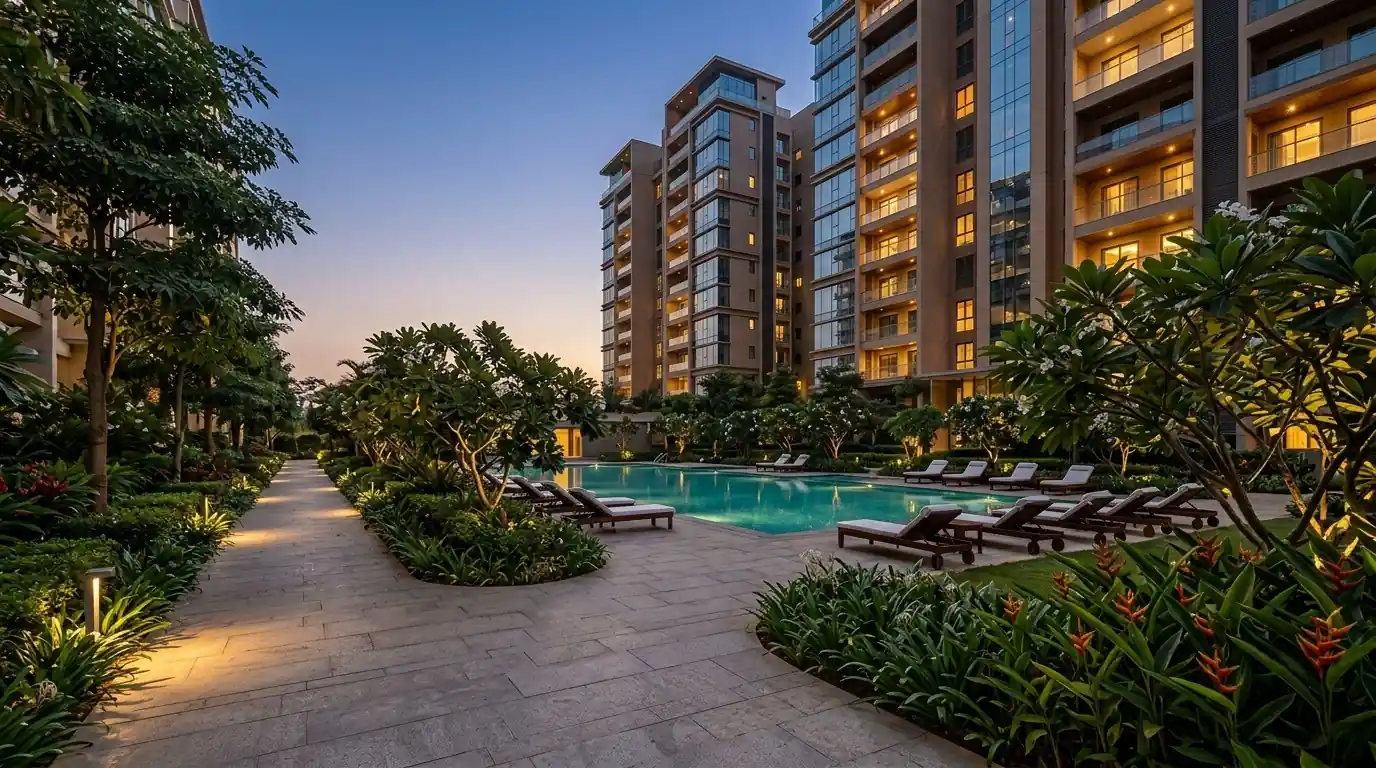
The 70 homes per acre ratio means that a meaningful proportion of the 3-acre site is dedicated to landscape, open space, and community zones rather than building footprint. It means that the 4 towers – Tower A with 2 units per floor and Towers B, C, and D with 4 units per floor – are spaced with enough separation to give each home genuine privacy and natural light penetration. It means that the approximately 10,000 sq ft clubhouse serves a community of 210 families rather than 600, which changes what that clubhouse actually feels like to use on a daily basis.
That ratio, at this location directly opposite Phoenix Market City, near Singayyanapalya Metro Station, on Whitefield Main Road, creates a product that the market simply does not have an alternative for. There is no other pre-launch low-density ultra-premium community at this address. There may not be again.
For buyers actively looking at Arvind ITPL Whitefield, the low-density positioning is not a secondary feature. It is a core investment thesis — one backed by the appreciation data, the rental yield data, and the consistent preference of the premium buyer and tenant demographic that this corridor generates.
Not every project that uses low-density language in its marketing is genuinely low-density. Here is what to verify before accepting the claim:
The actual unit-to-acre ratio. Divide the total unit count by the total land area in acres. Below 100 units per acre is genuinely low density. Above 150 units per acre regardless of the marketing language is not.
The open space allocation. A genuinely low density project dedicates at least 60 to 70% of its land area to open space, landscape, and community zones. Less than that, and the density is showing up in the built form even if the unit count sounds reasonable.
The tower count and floor count. A project with 4 towers across 3 acres delivers a fundamentally different community experience from one with 8 towers on the same land — even at the same unit count. Fewer towers mean more ground-level open space and a less overwhelming built environment.
The amenity sizing relative to unit count. Divide the clubhouse sq ft by the total unit count. For a genuinely premium low-density project, the ratio should be at least 40 to 50 sq ft of clubhouse per unit. Below that, the facilities will feel undersized for the community once fully occupied.
At 210 units, 3 acres, 4 towers, and approximately 10,000 sq ft of clubhouse space, Arvind ITPL Whitefield passes every one of these checks.
Low-density living in Whitefield is not a niche preference. It is a consistently better investment and a consistently better daily life, and the data on appreciation, rental yield, maintenance quality, and resale premium across Bangalore’s residential market confirms it.
The challenge is that genuinely low density projects on genuinely premium land are rare. Developers who voluntarily cap the unit count on prime land are making a deliberate choice that costs them revenue in the short term and creates value for buyers over the long term. That alignment of developer restraint with buyer benefit is worth paying attention to — and worth acting on before the pre-launch window closes.
What is considered low density in a Whitefield residential project?
Genuine low density in a premium Whitefield context means fewer than 100 homes per acre of land area. At 210 homes across approximately 3 acres — 70 homes per acre — Arvind ITPL Whitefield is meaningfully below that threshold and significantly lower density than most active projects on ITPL Main Road Whitefield and the broader Whitefield corridor.
Why do low-density apartments appreciate faster than high-density ones?
Low density projects on prime land create scarcity at the micro level — fewer homes competing for the same pool of buyers and tenants at resale. In a corridor with sustained and growing demand like ITPL Main Road Whitefield, that scarcity translates into consistent appreciation outperformance over a five- to ten-year holding period. The premium buyer and tenant demographic this corridor generates also actively prefers low-density communities — and that preference premium compounds into measurable price outperformance over time.
Is Arvind ITPL Whitefield genuinely low-density?
Yes. At 210 homes across approximately 3 acres—70 homes per acre—across 4 towers with a meaningful proportion of the site dedicated to open space and landscape, Arvind ITPL Whitefield is among the lowest-density ultra-premium residential communities currently planned on ITPL Main Road Whitefield. The approximately 10,000 sq ft clubhouse serving 210 families reinforces the low density positioning throughout the amenity offering.
What is the price of low-density apartments at Arvind ITPL Whitefield?
The warm-up price for Arvind ITPL Whitefield is ₹17,500 per sq ft onwards. EOI is ₹5 Lakhs on behalf of Arvind SmartHomes Private Limited. Expected possession is 2031. The project offers 3 BHK and 4 BHK configurations ranging from approximately 1,860 sq ft to 4,200 sq ft, including a distinctive 3.5 BHK duplex.
How does low density affect the amenity experience in a gated community?
In a high-density community, amenities are shared among a significantly larger resident pool — which means longer queues at the gym, more competition for pool time, and common areas that feel like public spaces rather than private community extensions. In a 210-home, low-density community like Arvind ITPL Whitefield, the same amenities serve fewer residents — which means the clubhouse, pool, and outdoor spaces are genuinely usable at the scale and standard they were designed for on any day of the week.
What are the tower details of Arvind ITPL Whitefield?
Arvind ITPL Whitefield has 4 towers — Tower A with 2 units per floor and Towers B, C and D with 4 units per floor each — across a 2 Basements plus Ground plus 16 Floors structure on approximately 3 acres of Whitefield Main Road. The low tower-to-land ratio ensures meaningful separation between buildings and genuine open space at ground level.
Pre-Launch Site Visit Checklist: What to Check and Ask Know More Contents Visiting a project that hasn’t been built is
How to Judge a Clubhouse Before You Buy an Apartment Know More Contents A clubhouse sells flats. The render shows
Which Floor Is Best in a High-Rise? What Actually Changes by Level Know More Contents People ask which floor
East, West and North-Facing Flat? How to Test Before You Book Know More Contents Ask ten buyers which direction a
Arvind ITPL Review: What’s Confirmed and What to Ask Know More Contents If you’ve searched for an Arvind ITPL review,
3 BHK vs 4 BHK Luxury Apartments in Whitefield — Which Is the Better Investment in 2026? Know More Contents
WhatsApp us
Download Brochure | Schedule Your Site Visit | Avail Pre Launch Offers